What Really Matters for an E-commerce Brand in 2026: Titles, Pricing, SEO and Site Hygiene, Ranked
- Amazon titles are now capped at 75 characters plus 125 of Item Highlights. Clear beats keyword-stuffed, on Amazon and on your own store.
- Show the real price early. Late fees and fake discounts kill checkouts and trust.
- Titles, pricing, photos, trust and site hygiene sell. Founder story, consistency and logo build loyalty, but only after the basics work.
Rohan spent ₹1.2 lakh on his brand before he sold a single bottle. A beautiful logo. Custom packaging. A colour palette with a name.
Three months after launch, his store gets around 40 visitors a day. Orders? Almost none.
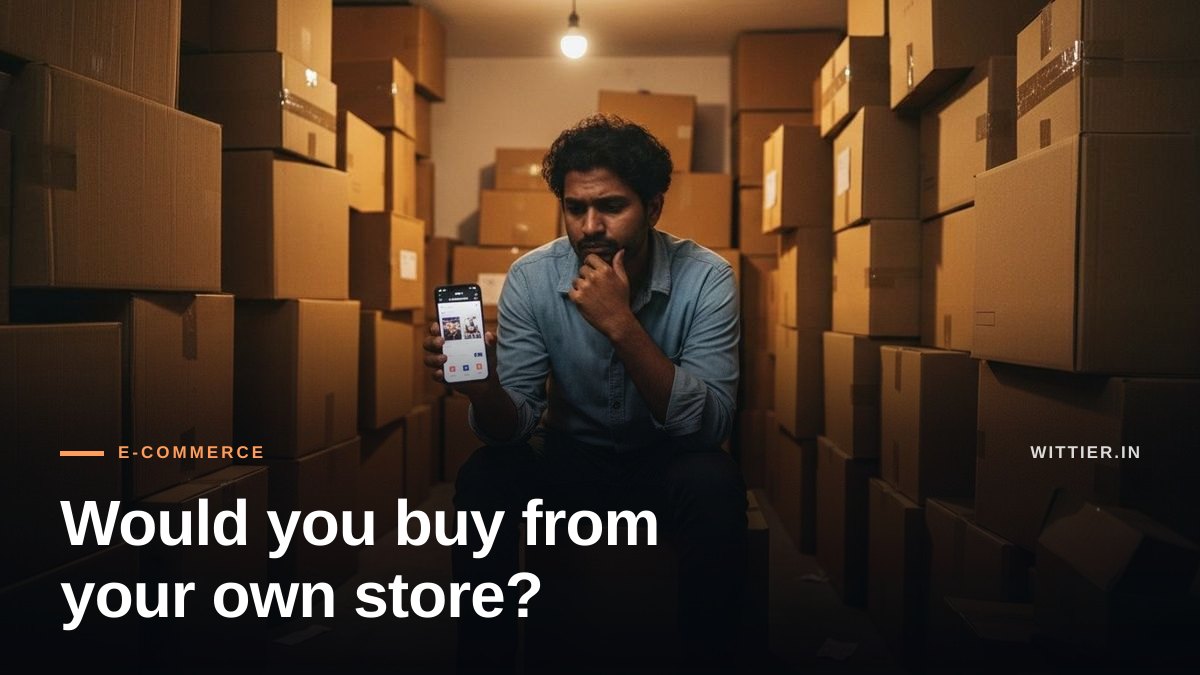
He is sitting in his storeroom, surrounded by boxes, scrolling his own website on his phone. And for the first time he asks the question every founder should ask on day one: would I buy from this store?
Rohan is a mix of the D2C founders we meet every month. The problem is almost never the logo. It is everything the customer actually sees in the three seconds before they decide to leave.
Ranked: what really matters for an e-commerce brand
Brand strategist Ian Barnard recently ranked the ingredients of a new brand from most to least important, and the logo landed near the bottom, below things like founder story, brand codes and consistency. We agree, and for an online store the list is even more practical. Here is our ranking, most important first:
| Rank | Ingredient | Why it matters |
|---|---|---|
| 1 | Product titles that make sense | The customer decides in seconds |
| 2 | Honest, upfront pricing | Surprises kill checkouts |
| 3 | Photos that answer questions | They replace touching the product |
| 4 | Trust: reviews, returns, a real contact | Strangers need proof |
| 5 | Website hygiene | Speed, working checkout, no broken pages |
| 6 | SEO titles and meta descriptions | How Google shows you before the click |
| 7 | Founder story | Why you, not a marketplace seller |
| 8 | Brand consistency | Same colours, tone and packaging everywhere |
| 9 | Logo | Needed, but it sells nothing on its own |
Most new brands invest in exactly the reverse order. Let us go through the ones that decide your sales.
1. Does your product title actually make sense?
Amazon just made this impossible to ignore. Since 27 July 2026, Amazon product titles in almost every category must be 75 characters or fewer, including the brand name and spaces. A new Item Highlights field adds 125 more characters for materials, use cases and compatibility, and it is searchable too. Long titles are being replaced with AI-suggested versions that sellers get 14 days to review. (Selling on Amazon.in? Check your Seller Central notices for how it applies to your categories.)
The lesson is bigger than Amazon. For years, sellers stuffed titles with every keyword they could think of. The result reads like this:
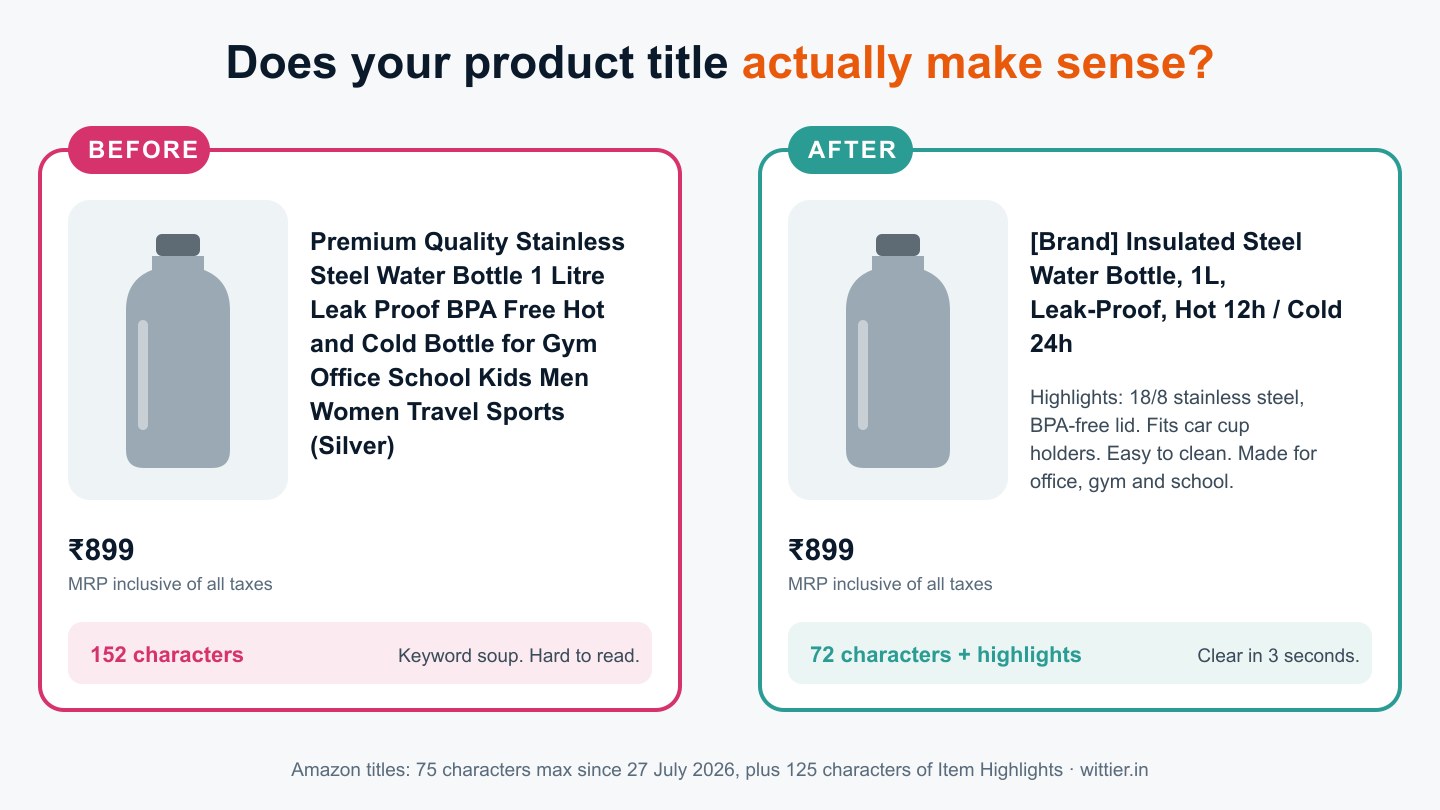
A good product title answers four questions, in this order: what is it, what makes it different, what size or variant, and who makes it. Everything else goes in highlights, bullets and the description.
Before you publish any product, ask:
- Can a stranger understand the product in three seconds?
- Are the key attributes (size, material, quantity) clear?
- Is every word earning its place, or just adding noise?
More keywords do not make a better title. Clear ones do, for shoppers and for the search systems reading your page.
2. Pricing: no surprises, ever
The fastest way to lose a sale is at checkout. A shopper sees ₹899, adds to cart, and discovers ₹99 shipping and a ₹49 "convenience fee" on the last screen. They leave, and many never come back.
What good stores do:
- Show the real price early. Delivery charges, COD fees and free-shipping thresholds belong on the product page, not the last step.
- Keep discounts honest. A permanently "70% off" price with an inflated MRP fools nobody for long, and damages trust in everything else you say.
- Show what the law requires. MRP inclusive of all taxes, and the other product details under Legal Metrology rules.
- Skip the tricks. India's consumer protection authority has specifically called out dark patterns like drip pricing (fees revealed late) and false urgency ("only 2 left!" when there are 200).
A price that holds from product page to payment is one of the strongest trust signals a new brand has.
3 and 4. Photos and trust
Online, photos replace touching the product. Show the product in use, show scale (in a hand, on a desk), show the label and the texture, and keep every photo the same size and style.
Then answer the question every first-time buyer is silently asking: is this store real?
- Genuine reviews, including the odd 4-star one. Perfect 5.0 ratings look fake.
- A clear returns and refund policy, written in plain language.
- A real phone number, email and address, and the grievance officer details e-commerce businesses in India are required to show.
5. Website hygiene: the boring stuff that loses the most money
Hygiene is invisible when it works and fatal when it does not. Once a month, check:
- Speed on a phone, on mobile data. Heavy images are the most common culprit. Compress them.
- Checkout, end to end. Place a real test order with UPI and with COD. You would be surprised how often something is quietly broken.
- Broken links and empty pages. Old campaign links, deleted products, 404s.
- Out-of-stock products. Do not delete the page. Keep it, mark it out of stock and offer "notify me", so you keep its Google ranking.
- Search on your own site. Type a product name with a small spelling mistake. Does it still find it?
- HTTPS everywhere, working policy pages, and a sitemap that is up to date.
6. SEO titles and meta descriptions: your shop window on Google
Before anyone sees your page, they see how Google shows it: a blue title and two lines of description. Most stores leave these on default, so every product looks the same in search results, or worse, shows the store name ten times.
For every product and category page, write:
- A page title of roughly 50 to 60 characters, with the product first and the brand last: Insulated Steel Water Bottle 1L, Leak-Proof | [Brand]
- A meta description of roughly 140 to 160 characters that sells the click: Keeps drinks hot for 12 hours and cold for 24. Leak-proof, BPA-free, fits car cup holders. Free delivery above ₹499, easy 7-day returns.
A few more that most stores miss:
- Write your own descriptions. Copying the manufacturer's text means your page is identical to a hundred others.
- Category pages matter more than you think. "Steel water bottles" is searched far more than any single product name. Give category pages real text, not just a grid.
- Add product structured data (price, availability, reviews), so Google can show rich results with stars and price.
- Name images properly and write alt text that describes them.
Google may rewrite your description sometimes. Write a good one anyway: it is used far more often when it genuinely matches the page.
7 to 9. Founder story, consistency, logo
These still matter. They are what turn a first order into a loyal customer. Tell people why you started, keep the same colours, tone and packaging everywhere, and yes, have a good logo.
Just do not start there. A beautiful logo on a confusing product page is still a confusing product page.
What Rohan changed
He did not touch the logo. He rewrote his top 20 product titles, moved the delivery charge onto the product page, reshot three products in use, fixed a checkout step that failed on UPI, and wrote proper titles and meta descriptions for his categories.
That is not a rebrand. It is a weekend of hygiene, and it is usually where the money is hiding.
Want a second pair of eyes on your store?
Send us your store link or your top Amazon listings. We will tell you honestly what we would fix first: titles, pricing clarity, speed, SEO and checkout. If you need a new store or a rebuild, our website plans start at ₹35,000 with fixed prices, and product and catalogue pages can be added as you grow.
Tell us about your store or WhatsApp us at +91 86603 99438.
Need a website that is compliant and secure from day one?
We build data-driven websites, web apps and platforms with compliance and security handled properly. Tell us about your project.
Get a free quoteThis article is general information, not legal advice. For your specific situation, please consult a qualified professional.