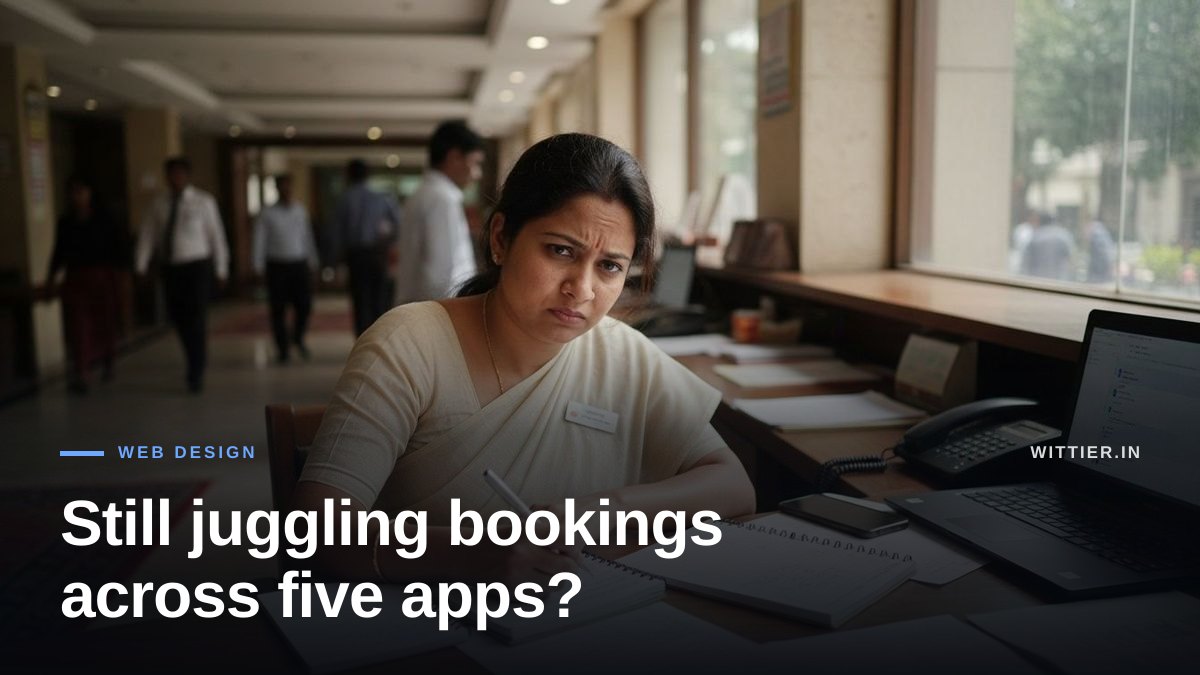
What Happens After Discharge? Why We Built Hitaishi
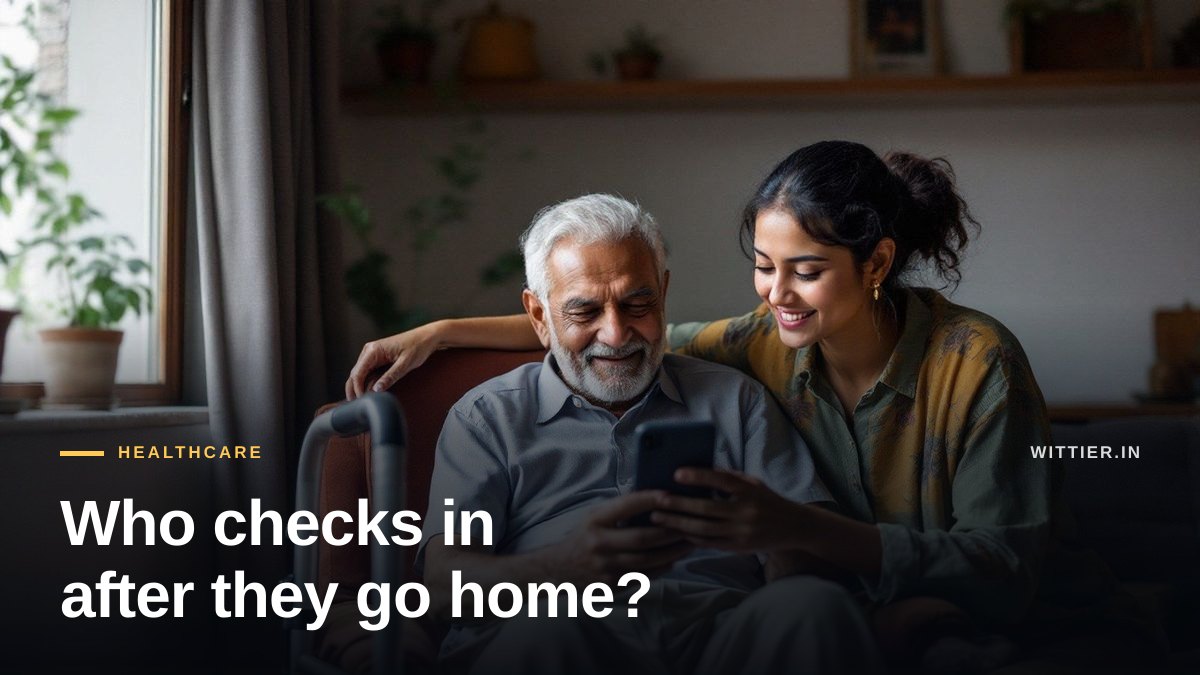
- Recovery after discharge happens at home, where most hospitals have no routine way to see how patients are doing.
- Hitaishi checks in daily on WhatsApp, keeps family in the loop with their own consent, and alerts the care team on rules your own clinicians set.
- It is built and pre-launch: we are inviting hospitals to a 60-day pilot at one unit, with no HIS changes needed.
The surgery went well. The patient leaves the ward with a walker, a discharge summary, a bag of medicines and a phone number to call "if anything happens".
Then the next six weeks happen at home.
For most hospitals, that is where the picture goes dark. The surgeon sees the patient again at the first review. Between discharge and that visit, the recovery is in the hands of the patient, a worried family and whatever they remember from the discharge briefing.
We built Hitaishi to close that gap. This is why, and how it works.
The gap after discharge
If you run a hospital or a surgical unit, none of this will surprise you.
- Families are unsure what is normal. Is this swelling expected on day five? Is a pain score of six fine? They call the ward, message the surgeon's personal number, or wait and hope.
- Exercises slip. Physiotherapy is hard to keep up at home, especially for older patients, and nobody notices until the review.
- Follow-up visits get postponed. A missed review is rarely a decision. It is usually just a busy week.
- Care teams hear late, if at all. A nurse or coordinator calling every patient works for a handful of patients. It does not scale to a full surgical list. Problems surface at the next OPD visit, or in emergency.
None of this is a failure of the surgeon or the nursing staff. It is a gap in the system. Hospital processes are built around a patient who is in the building. After discharge, there is no process, only goodwill.
Why WhatsApp, and not another app
The obvious fix is an app. We decided against it early.
An app has to be found, downloaded, signed into and remembered. For a 68-year-old a few days after knee replacement, every one of those steps is a reason to give up. WhatsApp is already on the phone, already trusted, and already the way families in India talk to each other.
So Hitaishi lives there. Each morning the patient gets a short check-in from the hospital's care team: pain from 0 to 10, how the wound looks (with an optional photo), fever, calf pain, and whether they managed their exercises. Most answers are a single tap, and it takes under a minute. Physiotherapy and follow-up visits can be booked in the same chat. Typing HELP reaches the team. Typing STOP ends the messages.
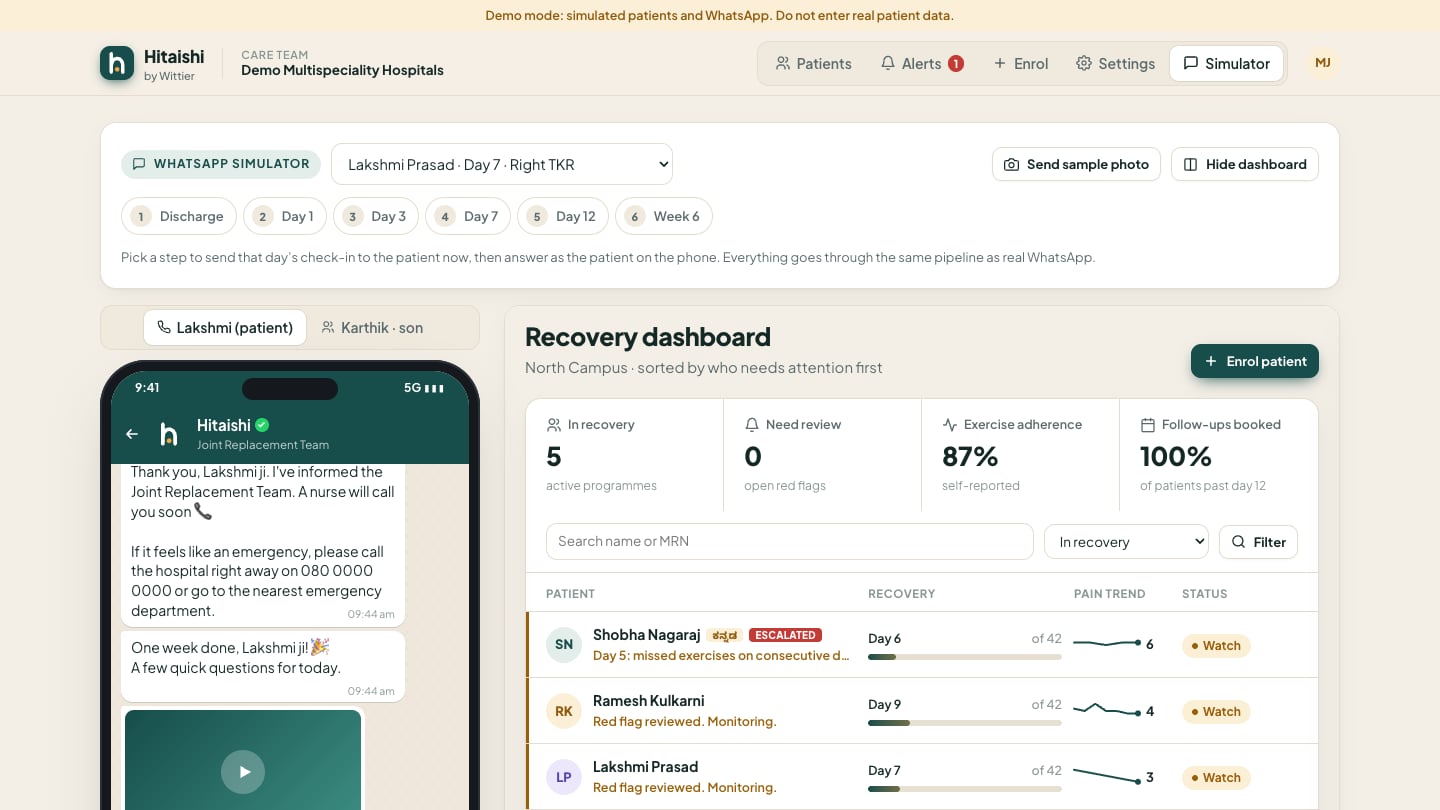
Automated messages from a hospital need Meta's official WhatsApp Business Platform, a verified business account and approved message templates. Hitaishi is built on that platform, not on a personal number or a workaround.
Family in the loop
In India, recovery is a family project. Often it is a son or daughter who manages the phone, reads the messages and decides when to call the doctor.
Hitaishi treats them as part of the care team's picture, with their own consent. A family member can get a short evening update, a message when the care team has been alerted or when the patient stops replying, and the daily check-in itself, which they can answer on the patient's behalf when needed. The record shows who answered, so the care team always knows whether a pain score came from the patient or from their son.
There is one deliberate exception. The validated outcome questionnaires are answered by the patient only, because that is what makes the scores valid.
Your clinicians set the rules, not us
This is the part we were most careful about.
Hitaishi does not diagnose and does not give medical advice. It is a communication and follow-up tool. It asks the questions your clinicians choose, checks each answer against the rules they set, and brings the ones that matter to the right people.
A rule might read: pain at or above 7, alert the nurse and the coordinator. Your surgeons decide the thresholds, the severity, who gets alerted for each rule and the escalation times. The default thresholds that ship with the knee and hip pathway are only a starting template, to be reviewed and signed off by your surgeons before go-live. Every change is saved as a new version and recorded in the audit log.
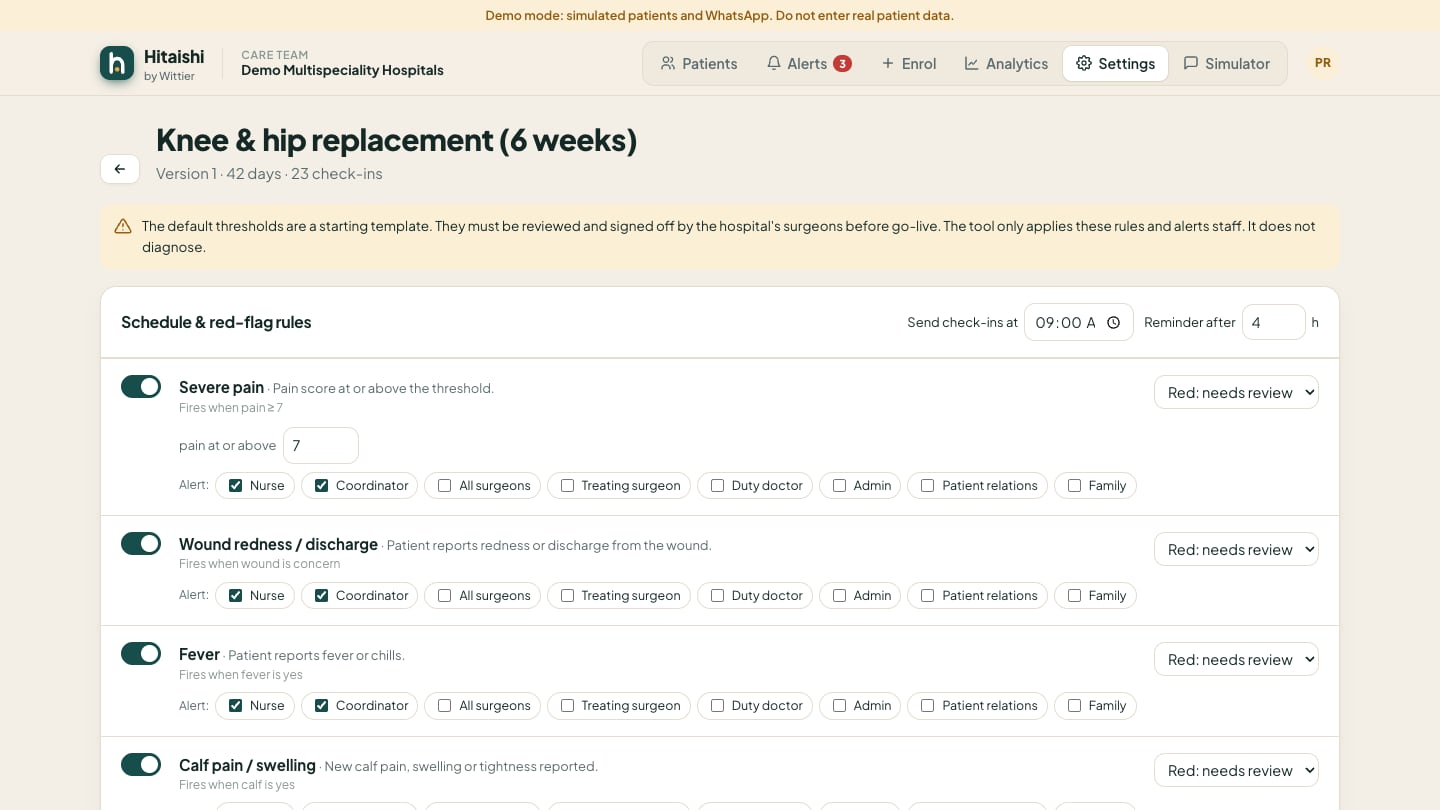
Alerts do not sit in an inbox. If nobody acknowledges a red flag, it escalates: to the coordinator after 15 minutes, then to the treating surgeon or the unit's duty doctor after 30, on WhatsApp and SMS. Your clinicians can change those times. If a patient misses three check-ins in a row, a red alert asks the team to call the patient or their family. And the patient is always told to call the hospital or go to the nearest emergency department if something feels urgent.
What the care team sees
On the hospital side, Hitaishi is a web dashboard that works in any browser.
- Patients sorted by who needs attention first, with day of recovery, pain trend and exercise adherence at a glance.
- One record per patient: every answer and who gave it, wound photos, pain and outcome-score charts and the full chat.
- Every review, call and note on the record, with role-based access for nurses, coordinators, surgeons and admins.
- Validated outcome scores: KOOS JR for knee replacement and HOOS JR for hip replacement, collected on WhatsApp at baseline, week 6, month 3 and month 12.
- Analytics and a printable pilot report that sets the baseline you agree at the start beside the pilot period.
Privacy is the foundation, not a feature
Recovery data is health data, and health data is as sensitive as personal data gets. Hitaishi is designed around India's Digital Personal Data Protection Act, 2023 from the first screen.
- Consent per purpose. A patient cannot be enrolled without recorded consent. Care messages are required; anonymised benchmarking is optional and can be withdrawn on its own. The patient also confirms on WhatsApp before check-ins begin.
- Family members give their own consent. Nobody is messaged because someone else agreed on their behalf.
- Data hosted in India, with patient and family names and phone numbers encrypted field by field.
- Two-factor sign-in for staff and an append-only audit log of every view and action.
If you want the background on what the law expects, we have written about what the DPDP Act means in practice, how to write a consent flow that holds up and data protection by design.
No IT project to get started
With hospital software, the tool is rarely the hard part. The integration is. So Hitaishi runs alongside your existing systems. A nurse or coordinator enrols the patient from the dashboard at discharge in about a minute, one by one or from a CSV or Excel list. No HIS integration and no changes to your IT systems are needed to begin.
How a pilot works
We are offering a 60-day pilot at one unit. In outline:
- Choose the unit. Knee and hip replacement is the first pathway, so an orthopaedic unit is the natural start.
- Agree the baseline. Decide with your clinical and operations leads what you track today, so the pilot report compares against something real.
- Sign off the rules. Your surgeons review the red-flag thresholds, who is alerted and the escalation times before any patient is enrolled.
- Enrol at discharge. Your team enrols consenting patients as they go home, and the daily check-ins start the next morning.
- Review together. At the end, we go through the pilot report with you and you decide what happens next.
Where Hitaishi is today
We would rather be plain about this.
Hitaishi is built and runs end to end in demo mode, with a WhatsApp simulator. Sending on real WhatsApp starts once Meta approves the business account and message templates. It is not yet in use at any hospital, and every screenshot in this article is demo data with simulated patients. English is ready today; Kannada and Hindi are being translated by people and reviewed by clinicians before they are used. Knee and hip replacement is the first pathway, with spine, cardiac and oncology planned.
That is exactly why we are looking for our first pilot hospitals: teams who want a say in how post-discharge follow-up should work, and are willing to try it on one unit first.
Why "Hitaishi"
Hitaishi (ಹಿತೈಷಿ, हितैषी) means "well-wisher". It is the person who checks in, not because they have to, but because they want you to be all right. That is what we want every patient to feel in the weeks after they go home, and what we want every care team to be able to offer without adding a single phone call to their day.
If you lead a hospital, a surgical unit or a nursing team, see how Hitaishi works, or book a demo and we will plan a 60-day pilot with you. You can also WhatsApp us at +91 86603 99438.
Run a surgical unit? Try Hitaishi for 60 days.
Daily WhatsApp check-ins after discharge, red-flag alerts on rules your clinicians set, and no changes to your HIS. We are inviting hospitals in India to a 60-day pilot at one unit.
See how Hitaishi worksThis article is general information, not medical or legal advice. Hitaishi is a communication and follow-up tool: it does not diagnose or give medical advice, and clinical decisions stay with your clinicians.